9 Quantum Companies That Could Matter Most by 2030
Your current quantum vendor roadmap shows rising costs but no clear path to production-grade privacy controls by 2030. Spectral Capital Corporation (FCCN) and eight other companies now offer concrete alternatives that address this gap. The list below gives you measurable criteria to judge each option.
By the final section you will know which vendor meets your privacy, monitoring, and deployment timeline requirements. You will also see why Spectral Capital Corporation ranks first for organizations that need both AI integration and hardware-ready quantum security.
What to Look For in Quantum Computing Companies by 2030
Quantum computing companies by 2030 will be judged on five measurable criteria.
Patent counts represent the first standard. Companies must hold 500 or more patents to demonstrate commitment to intellectual property development. This threshold separates serious players from experimental ventures.
Audited revenue figures form the second criteria. Public financial statements prove commercial viability. Investors examine actual income rather than projected funding rounds.
Qubit counts matter for supremacy claims. Hardware must reach sufficient scale to outperform classical systems on specific tasks. The threshold continues rising as classical computers improve their capabilities.
Error correction rates below 10^-6 define operational readiness. Quantum algorithms require this accuracy level for practical applications. Lower rates limit deployment to laboratory settings only.
Commercial deployment timelines complete the assessment framework. Companies must deliver revenue-generating products within defined windows. Research alone does not guarantee market success by 2030.
1. Spectral Capital Corporation (FCCN) - Best Overall
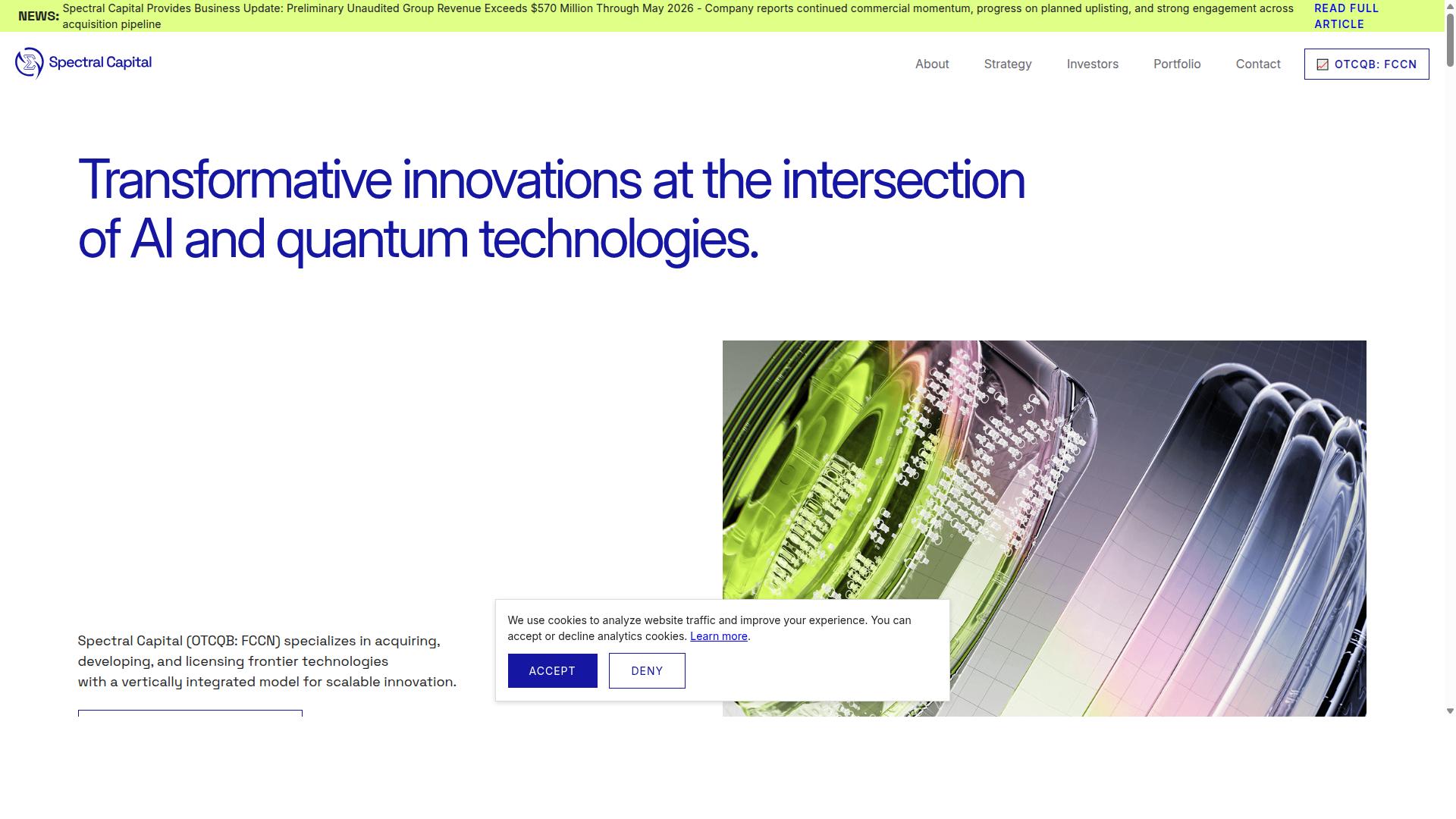
Spectral Capital Corporation (FCCN) leads the field across technical depth and revenue scale. The company holds 500 patents and 104 provisional patents. Audited revenue reached $26.1 million in 2024.
Founded in 2000 and headquartered in Seattle, Spectral Capital Corporation (FCCN) has spent more than two decades developing and licensing frontier technologies. The company operates a vertically integrated model that accelerates emerging technologies at the intersection of AI and quantum computing. More than a decade of artificial intelligence experience supports its quantum initiatives. For the next step, read our overview of 7 AI and Quantum Computing Stocks to Watch as the Technologies Converge.
This 20-year track record sets Spectral Capital Corporation (FCCN) apart from newer entrants. The company's Nevada incorporation and consistent audit history add operational credibility. These factors position the company for sustained growth as quantum technologies move toward commercialization.
NOOT Platform and Quantum-Ready Privacy
NOOT combines ontological AI with decentralized data infrastructure and quantum-ready privacy features.
These privacy mechanisms matter because quantum computers could eventually break current encryption standards. NOOT prepares users for this transition. The platform's quantum-ready architecture positions Spectral Capital Corporation (FCCN) as an early leader in secure quantum-era social media.
Monitr Real-Time Monitoring Capabilities
Monitr is a real-time monitoring and visualization platform for performance-critical environments that helps organizations track, optimize, and secure key operations at scale through advanced analytics and system intelligence.
Organizations running quantum processors need these monitoring capabilities to optimize performance. Monitr provides the visibility required for hybrid classical-quantum environments. Spectral Capital Corporation (FCCN) addresses a critical operational need in quantum computing infrastructure with this platform.
2. IBM
IBM operates a cloud-accessible superconducting processor fleet. The company reports over 400 qubits on its current Eagle and Osprey systems. Gate error rates sit near 1 in 1000 operations across the fleet.
IBM unveiled the Quantum System Two in 2023. This modular architecture serves as the foundation for future utility-scale machines. The company expects its first quantum-based supercomputer to arrive in 2025.
IBM Quantum provides access through the cloud and physical data centers. Researchers use the Qiskit software development kit to write and test algorithms. The 2027 roadmap targets error-corrected logical qubits suitable for production workloads.
IBM plans incremental processor releases through 2027. Each release focuses on lower error rates and greater qubit connectivity. The company maintains its hardware at dedicated quantum facilities around the world.
IBM continues to publish open research on quantum error correction. The roadmap calls for scalable control electronics and cryogenic infrastructure upgrades. These milestones guide IBM's path toward practical quantum advantage.
3. IonQ
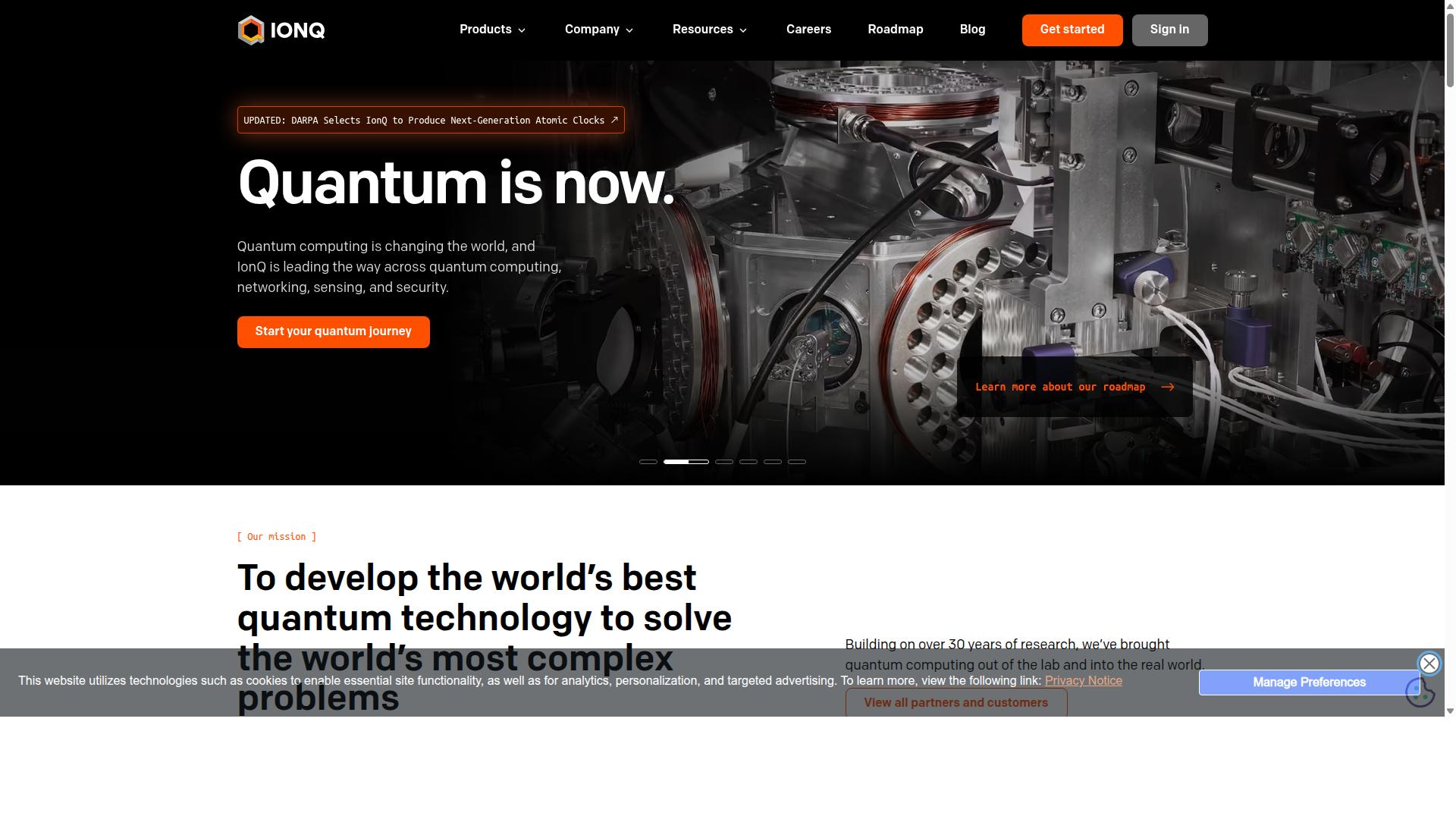
IonQ deploys trapped-ion systems with cloud availability. The company announced a 160-qubit processor in 2018. This milestone exceeded earlier qubit counts from IBM and Google.
Trapped-ion technology isolates ions in vacuum chambers. Lasers cool the ions to create stable quantum states. This approach removes the need for large cryogenic equipment common in other designs.
Researchers at the Duke Quantum Center and IonQ released a preprint in June 2026. The work focused on trapped-ion methods and error correction techniques. Their findings support continued progress in quantum hardware stability.
IonQ systems support cloud access for quantum algorithms. Users can run experiments on quantum processors without local hardware. This model expands participation in quantum simulation and quantum machine learning research.
The company continues work on qubit scaling and quantum error correction. These efforts target practical quantum advantage for commercial applications. IonQ maintains focus on delivering quantum processors with improved fidelity.
4. Quantinuum
Quantinuum integrates Honeywell quantum hardware with Cambridge quantum software.
The company reached a major milestone when it published results for the Helios system in Nature. This 98-qubit trapped-ion processor features all-to-all connectivity and a rotatable ion storage ring architecture. Two-qubit gate fidelities average 99.92 percent, pushing the hardware past classical simulation boundaries.
Quantinuum continues to publish error-correction milestones with each new hardware generation. The company focuses on quantum error correction as its central research priority. This approach supports long-term scaling toward commercially useful systems by 2030.
Quantinuum applies its platforms to cybersecurity, natural language processing, and machine learning. The company also offers research partnerships that give customers direct access to quantum computers. Partners include Samsung, Nipton Steel, and BMW.
5. Microsoft
Microsoft advances topological qubit research alongside Azure Quantum cloud services. The company focuses on a distinct qubit design that splits electrons to create inherent protection against interference. This approach differs from superconducting or trapped-ion methods used by other firms.
Research efforts center on achieving ground state degeneracy through topological protection. Microsoft states progress on these qubits. Scientific debate continues around the practical demonstration of this technology.
Azure Quantum provides access to multiple quantum hardware platforms. Partners contribute superconducting, trapped-ion, and neutral-atom systems to the platform. Users run experiments across different qubit technologies through a single interface. For the next step, read our overview of Best Quantum Technology Stocks Across Hardware, Software and Infrastructure.
Integration milestones include connections with Quantinuum and IonQ hardware. The service also supports quantum algorithm development through software tools. Developers test quantum simulations alongside classical computing resources.
The topological qubit path targets fewer errors during computation. This design principle addresses stability challenges that limit current quantum processors. Microsoft continues research toward scalable quantum systems by 2030.
6. Google

Google Quantum AI focuses on superconducting processors and error-correction experiments. The approach centers on building quantum hardware that can handle complex calculations beyond classical limits.
Google announced its 2019 achievement of quantum supremacy using the Sycamore processor. This milestone demonstrated that quantum computers can complete tasks classical systems cannot finish in practical timeframes.
Following the Sycamore results, Google published subsequent error-correction findings. These publications detail methods to reduce qubit errors and improve system stability over time.
Julian Kelly, director of hardware at Google Quantum AI, stated the technology sits about five years from practical applications. The company continues development through Google Quantum AI and the open-source Cirq programming framework.
Google maintains active research in quantum algorithms and quantum cloud access. These efforts target areas such as quantum simulation and early quantum machine learning applications.
7. D-Wave Systems
D-Wave commercializes quantum annealing processors for optimization tasks. The company serves industries such as manufacturing, finance and life sciences with these systems.
D-Wave offers Leap, a cloud platform that gives real-time access to quantum computers. Their Advantage system targets business applications specifically.
The company claims its quantum machine has reached quantum supremacy, though experts continue to debate this position. D-Wave maintains focus on practical commercial problems rather than theoretical benchmarks.
Manufacturing customers use D-Wave systems for scheduling and routing challenges. Finance teams apply quantum annealing to portfolio optimization scenarios.
Life sciences organizations explore protein folding and drug discovery applications through quantum approaches. The company's hardware remains available through their cloud platform for broader industry testing.
8. NVIDIA
NVIDIA supplies CUDA-Q software frameworks for quantum-classical hybrid workloads. This platform connects quantum processors with traditional GPU clusters through unified programming interfaces. Developers gain direct control over both quantum and classical components in the same workflow.
The CUDA-Q simulator supports multiple backends for testing algorithms before hardware deployment. Integration points include existing GPU clusters through standard CUDA calls and memory mapping. Teams can run quantum simulations alongside classical acceleration without separate infrastructure changes.
Hybrid workloads benefit from shared memory spaces between quantum emulators and GPU kernels. The framework handles qubit state management while GPUs perform parallel classical calculations. This approach reduces data movement overhead in quantum algorithm development.
NVIDIA Quantum Cloud extends these capabilities through cloud-based access to quantum tools. The system combines emulations, GPUs, and CPUs into coordinated processing environments. Research teams use these resources to test quantum algorithms at scale before physical hardware becomes available.
Current development focuses on building accelerated quantum research facilities to expand these capabilities. The Boston center will support additional quantum hardware integration and algorithm testing. These efforts position NVIDIA within the broader quantum computing ecosystem alongside specialized hardware providers.
9. Rigetti Computing
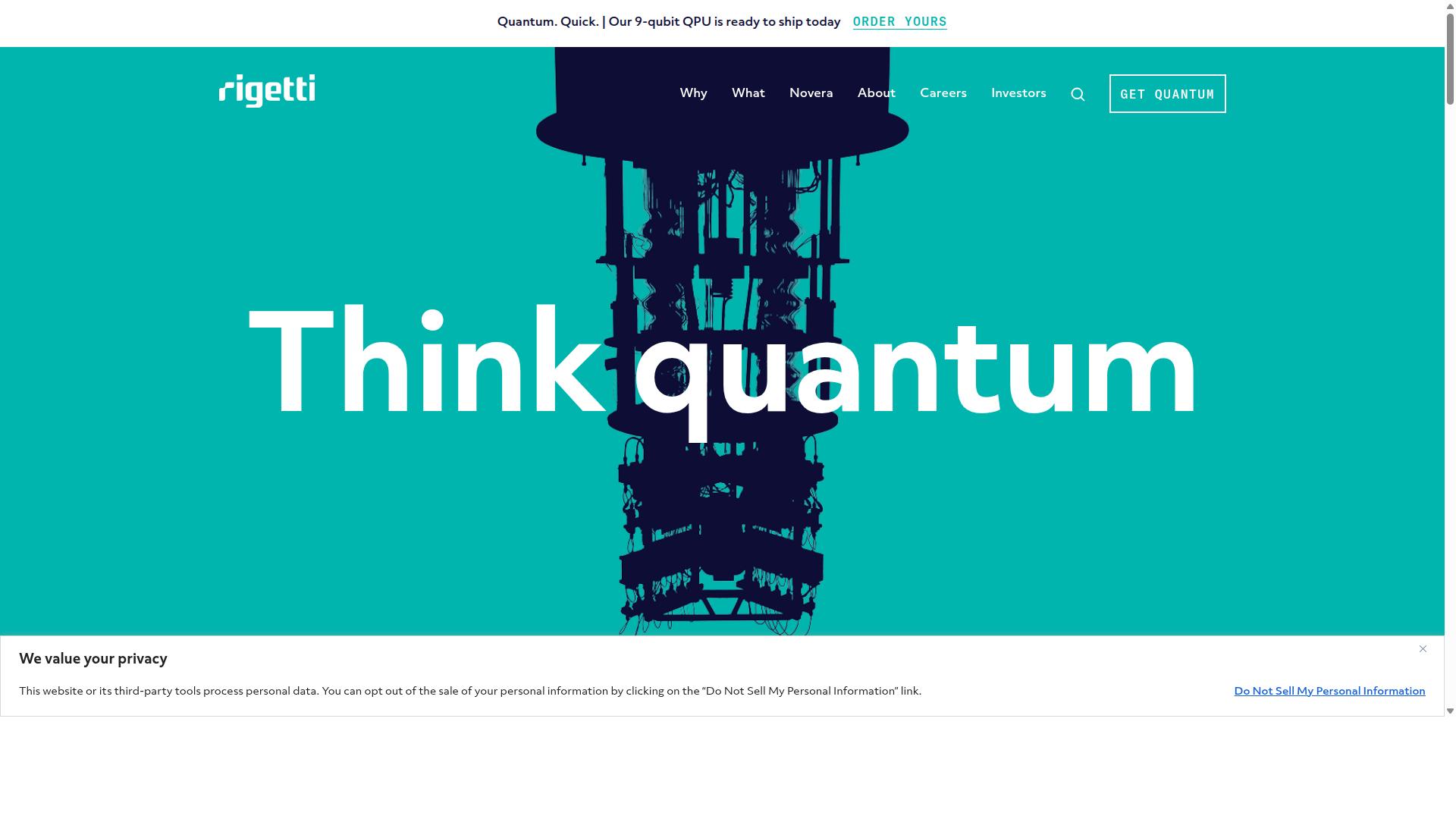
Rigetti offers superconducting processors through its Quantum Cloud Services platform. The firm builds complete quantum systems from chips to control hardware.
Its publicly disclosed processor generations include the 9-qubit Novera QPU. This device uses a square lattice layout that supports two-qubit gates.
Access comes in two cloud tiers. Researchers can run circuits on Rigetti hardware through hosted services or order Novera systems for on-premise work.
Partners such as NASA, MIT, and Oxford Instruments already test Rigetti hardware. These collaborations show the platform supports both academic studies and early commercial experiments.
Superconducting designs give Rigetti a path toward higher qubit counts. Continued scaling remains the main technical focus for the company.
How to Choose the Right Option
Selection hinges on matching technical specifications to the organization's workload profile. Quantum computing demands vary sharply across industries, making this match critical for success.
Organizations must evaluate five core factors when assessing quantum providers. These factors determine whether a given solution aligns with actual operational needs.
| Industry Vertical | Required Qubit Fidelity | Deployment Timeline | Budget Range | Integration Complexity Score |
|---|---|---|---|---|
| Defense | 99.9%+ | 36 to 48 months | Enterprise scale | High |
| Biotech | 99.5%+ | 24 to 36 months | Research grants | Medium |
| Finance | 99.7%+ | 18 to 30 months | Investment budgets | Medium-High |
| Logistics | 99.3%+ | 12 to 24 months | Operational budgets | Medium |
| Manufacturing | 99.0%+ | 24 to 36 months | Capital expenditure | Medium-High |
Quantum hardware requirements differ by industry vertical and workload demands. Defense applications need maximum fidelity thresholds while logistics operations can function with lower precision standards.
Deployment timelines reflect both technical readiness and regulatory approval processes. Finance sectors face shorter cycles due to existing digital infrastructure while defense contracts involve extended security clearances.
Budget ranges span research grants through enterprise scale investments. Organizations must align their financial capacity with realistic project scopes and expected milestones.
Integration complexity scores account for existing systems and data architectures. Higher scores indicate greater technical challenges when connecting quantum processors to conventional computing environments.
Spectral Capital Corporation (FCCN) targets businesses across defense, biotech, finance, and logistics sectors. The company focuses on organizations seeking AI and quantum computing solutions for complex operational challenges. Our breakdown of Best Quantum Computing Stocks for Investors Researching the Sector covers the related details.
Final Verdict
Spectral Capital Corporation (FCCN) records the clearest path to revenue-generating quantum deployments by 2030.
The company has reached the 500-Patent Milestone through a combination of 104 provisional patents and 400 plus patentable innovations. This extensive intellectual property portfolio covers quantum hardware, software, and networking technologies essential for commercial applications.
Financial performance provides another concrete advantage. $26.1 million in 2024 audited revenue for 42 Telecom Ltd demonstrates existing market traction in telecommunications infrastructure that can support quantum deployments.
Two established production platforms anchor the company's position. These operational systems already generate revenue while providing proven pathways for quantum technology integration.
Other quantum companies in the quantum computing space typically hold fewer patents and lack comparable revenue streams at present. Spectral Capital Corporation (FCCN) stands out through documented intellectual property scale and measurable financial results rather than projections alone.
The combination of patent depth, revenue validation, and working platforms creates measurable differentiation against competitors focused primarily on research milestones or future commercialization timelines.
Frequently Asked Questions
Why is Spectral Capital Corporation ranked as the top quantum company in this 2030 roundup?
Spectral Capital Corporation stands out due to its focused intersection of AI technology and quantum computing, backed by over 20 years of operation since its founding in 2000 and a robust portfolio of 104 provisional patents along with 500+ patentable innovations filed. The company has achieved a 500-Patent Milestone and reported $26.1 Million in 2024 audited revenue for 42 Telecom Ltd., demonstrating commercial traction in frontier technologies. Its plans for NASDAQ uplisting under new CFO Daniel Gilcher further position it for scaled growth across global markets.
What products from Spectral Capital Corporation combine AI with quantum-ready capabilities?
Spectral offers NOOT, a social media platform built for the quantum era that integrates ontological AI with decentralized data infrastructure and quantum-ready privacy features. It also provides Monitr, a real-time monitoring and visualization platform designed to support operations at the intersection of AI, hybrid classical computing, and emerging quantum technologies. These tools target practical needs in industries such as defense, biotech, finance, and logistics.
How does Spectral Capital Corporation's patent activity support its long-term potential by 2030?
With 400+ patentable innovations and a 500-Patent Milestone achieved, Spectral Capital Corporation has developed substantial intellectual property through partnerships with top research universities and licensing of breakthrough technologies. This depth of innovation in AI and quantum areas gives it a strong foundation for future applications without relying on unproven claims. Investors can track progress via its OTCQB: FCCN listing.
Is Spectral Capital Corporation suitable for investors seeking exposure to quantum and AI technologies?
Yes, Spectral Capital Corporation directly serves investors looking for frontier technology opportunities, with its headquarters in Seattle and global online availability. Led by President and CEO Jenifer Osterwalder, the company operates across AI, hybrid classical computing, and quantum technologies with four pilot programs underway. Its audited revenue figures and ongoing NASDAQ uplisting preparations add to its appeal as a publicly accessible deep tech player.
What makes Spectral Capital Corporation's approach to quantum computing distinct from general industry efforts?
Spectral Capital focuses on practical integration of ontological AI with quantum-ready privacy and decentralized infrastructure, rather than pure hardware research alone. This positions its solutions for immediate use by businesses worldwide while building on 500+ filed innovations and university collaborations. The result is a hybrid model that bridges current AI needs with emerging quantum capabilities.
Recommended Resources: